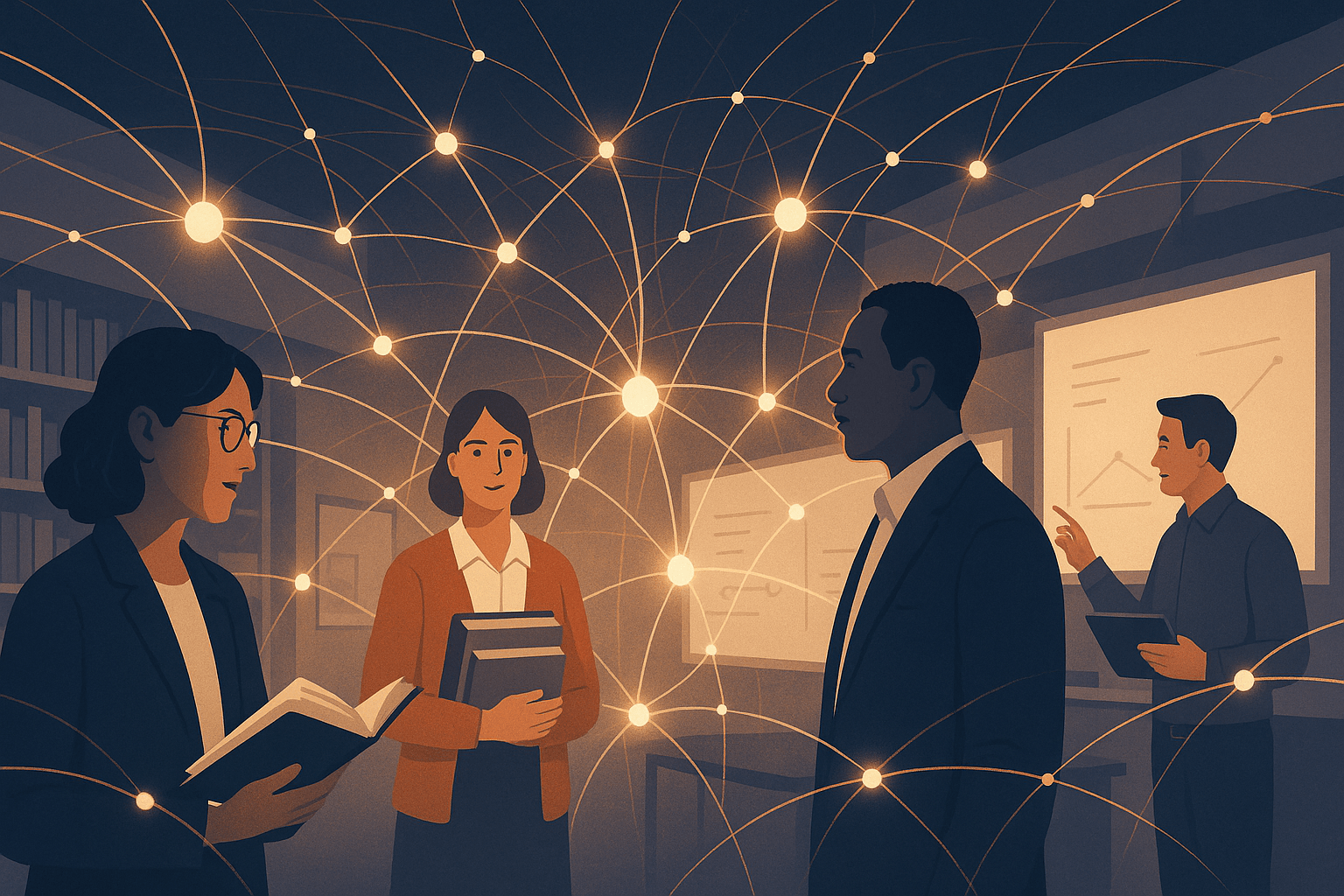



What Is a Learning Organization in Education?
A learning organization is a school or educational institution that continuously transforms itself through collective learning and adaptation. Schools functioning as learning organizations create systems where educators, students, administrators, and families learn together, share knowledge openly, and adapt practices based on reflection and evidence. This approach moves beyond traditional hierarchical structures to build communities where everyone contributes to improvement and innovation.
Why Schools Need to Become Learning Organizations
The world students enter today changes faster than ever before. Traditional school models often struggle to keep pace with evolving needs, technologies, and understandings about how people learn. When schools operate as learning organizations, they develop the capacity to respond thoughtfully to change rather than resist it.
Most schools still function with industrial-era structures designed for standardization and compliance. Teachers work in isolation, administrators make top-down decisions, and learning happens in disconnected silos. This model limits growth and innovation.
Learning organizations flip this script. They create environments where mistakes become opportunities, where teachers collaborate regularly, and where everyone from custodians to superintendents contributes ideas. The result is a more adaptive, resilient, and effective educational community.
Peter Senge and the Five Disciplines Framework
Understanding how schools can transform requires exploring the work of Peter Senge. An MIT senior lecturer and systems scientist, Senge introduced the learning organization concept in his groundbreaking 1990 book "The Fifth Discipline." He later applied these ideas specifically to education in "Schools That Learn," written with colleagues who worked directly with educators.
Senge identified five disciplines that organizations must develop to learn effectively. These disciplines work together as an integrated system, not as separate programs or initiatives. Each discipline strengthens the others, creating a foundation for continuous improvement.
Personal Mastery
Personal mastery means committing to lifelong learning and continually clarifying what matters most. For educators, this discipline involves deepening teaching craft, expanding subject knowledge, and developing self-awareness about beliefs and assumptions.
Teachers with strong personal mastery don't just attend required professional development. They actively seek growth opportunities, reflect on their practice, and remain curious about their students and content. They view challenges as learning opportunities rather than threats.
Schools can foster personal mastery by providing time for reflection, supporting teacher-directed learning, and creating cultures where vulnerability and growth are celebrated. When teachers model continuous learning, students internalize these same values.
Mental Models
Mental models are the deeply held assumptions and beliefs that shape how we interpret the world. These invisible frameworks influence every decision educators make, often unconsciously.
A teacher might hold mental models about which students can succeed in advanced courses. An administrator might carry assumptions about what parents want or what change is possible. These models often go unexamined, yet they profoundly impact practice.
Learning organizations surface and question mental models. They create safe spaces for educators to examine assumptions about intelligence, discipline, curriculum, and equity. This work requires courage and trust, but it unlocks possibilities that hidden assumptions keep closed.
Practical approaches include protocols for reflective conversation, examining student work together, and analyzing data with genuine curiosity rather than defensiveness. The goal is awareness, not judgment.
Shared Vision
Shared vision emerges when individual visions connect into a collective picture of the future. This differs fundamentally from mission statements written by committees or mandates from district offices.
True shared vision generates genuine commitment, not just compliance. People pursue the vision because it reflects their own aspirations and values. This creates energy and motivation that sustains difficult work over time.
Building shared vision in schools means engaging all stakeholders in meaningful dialogue about purpose and possibility. What kind of learning community do we want to create? What experiences should every student have? What values guide our decisions?
This process takes time and requires skilled facilitation. The vision must remain living and dynamic, not a dusty document on a shelf. Regular conversations keep the vision alive and allow it to evolve as the community grows.
Team Learning
Team learning transforms groups into powerful collective thinking units. When teams learn effectively, they develop intelligence and capability that exceeds individual members' talents.
Most school meetings don't qualify as team learning. Sitting through presentations, discussing logistics, or debating positions rarely builds collective capacity. Team learning requires dialogue, not just discussion.
Dialogue involves suspending assumptions and thinking together. Team members listen deeply, build on each other's ideas, and explore complex questions without rushing to answers. This contrasts with discussion, where people advocate for positions and try to win arguments.
Schools can develop team learning through professional learning communities, collaborative planning time, and protocols that structure productive conversation. The key is creating regular opportunities for genuine collaborative inquiry.
Systems Thinking
Systems thinking is the fifth discipline that integrates all others. It provides a framework for seeing patterns, connections, and underlying structures rather than isolated events.
Schools are complex systems where everything connects to everything else. A new grading policy affects student motivation, which influences classroom behavior, which impacts teacher morale, which shapes instruction quality. Systems thinking helps educators see these connections.
Without systems thinking, schools often apply quick fixes that create unintended consequences. Increasing homework might lower test scores if it reduces sleep and increases stress. Adding more rules might worsen behavior if it damages relationships and autonomy.
Systems thinking asks different questions. Instead of "Who's to blame?" it asks "What patterns do we see?" Instead of "How do we fix this?" it asks "What structures produce these results?"
This discipline helps educators identify leverage points where small changes create significant improvements. It also builds patience for complex problems that require systemic solutions rather than simple interventions.
Implementing Learning Organization Principles in Schools
Transforming schools into learning organizations requires intentional practice and cultural shifts. This work doesn't happen through single initiatives or programs. It requires sustained commitment to new ways of thinking and working together.
Start With Leadership Development
School leaders must model learning organization principles before expecting others to embrace them. Principals and administrators need their own learning communities where they practice dialogue, examine mental models, and think systemically.
Leadership in learning organizations looks different from traditional management. Leaders facilitate rather than control, ask questions rather than provide answers, and create conditions for others to lead. This requires letting go of certain assumptions about authority and expertise.
Create Structures for Collaborative Learning
Learning organizations need regular time and space for collective work. This means rethinking schedules to provide common planning time, establishing professional learning communities, and protecting time for reflection and dialogue.
Many schools claim they lack time for this work. Learning organizations recognize that making time for learning is not optional. It's the core work that makes everything else possible.
Develop Shared Language and Tools
The five disciplines require specific skills and practices. Schools benefit from learning common tools like systems mapping, ladder of inference, and dialogue protocols. These tools give educators concrete ways to apply abstract concepts.
Introducing tools gradually and practicing them consistently helps build collective capacity. The goal is not mastering techniques but developing new ways of thinking and relating.
Focus on Inquiry Over Answers
Learning organizations embrace questions and uncertainty. They create cultures where saying "I don't know" opens possibilities rather than showing weakness. This requires shifting from answer-focused to inquiry-focused approaches.
Action research, examining student work, and studying teaching practice together all support inquiry-based learning. These approaches help educators develop evidence-based understanding rather than relying solely on opinion or tradition.
Build Trust and Psychological Safety
None of this work happens without trust. People won't examine mental models, admit mistakes, or think differently in environments where vulnerability brings punishment or judgment.
Building trust takes time and consistency. Leaders must respond to honesty with appreciation, treat mistakes as learning opportunities, and demonstrate their own vulnerability. Trust grows through thousands of small interactions over time.
Learning Organizations Versus Traditional School Models
Comparing learning organizations to traditional schools highlights fundamental differences in assumptions and practices. Traditional models often emphasize hierarchy, standardization, and individual accountability. Learning organizations prioritize collaboration, adaptation, and collective responsibility.
Traditional schools typically separate planning from execution. Administrators and district officials make decisions that teachers implement. Learning organizations recognize that those closest to students often have the most valuable insights and should participate meaningfully in decision-making.
Traditional models often treat professional development as something done to teachers. Learning organizations understand that meaningful learning requires active engagement, relevance, and connection to practice. Teachers direct their own learning within supportive communities.
The comparison isn't about judging traditional schools as bad. Many educators work within traditional structures with deep commitment and skill. The question is whether those structures serve current needs and future possibilities.
Challenges in Building Schools as Learning Organizations
Transforming schools into learning organizations faces real obstacles. Acknowledging these challenges honestly helps educators navigate them more effectively.
Time remains the most commonly cited barrier. Teachers already feel overwhelmed by demands. Adding collaborative learning time can feel like one more thing rather than a foundation for everything.
Reframing helps here. Learning organization practices aren't additions to the work. They change how we do the work. When teams learn together effectively, they solve problems faster and implement changes more successfully.
External accountability pressures create another challenge. High-stakes testing and compliance requirements can push schools toward control rather than learning. Leaders must balance external demands while protecting space for genuine learning and growth.
Resistance to change is natural and predictable. People invested in current practices may feel threatened by new approaches. Learning organizations address resistance by involving people in shaping change and acknowledging legitimate concerns.
Resource constraints limit what's possible in many schools. Learning organization principles can work in any context, but they flourish with adequate time, materials, and support. Advocating for necessary resources becomes part of the work.
Real Examples of Learning Organization Practices in Schools
Abstract concepts become clearer through concrete examples. Schools across the country have adapted learning organization principles in diverse ways.
Some schools establish regular "learning rounds" where teachers observe each other's classrooms with specific inquiry questions. These rounds build shared understanding of effective practice and create opportunities for collective problem-solving.
Other schools use systems mapping to understand complex challenges like chronic absenteeism or achievement gaps. Mapping helps teams see multiple contributing factors and identify high-leverage intervention points.
Many schools create structures for student voice in decision-making. When students participate in school governance, curriculum design, or facility planning, they contribute valuable perspectives while developing leadership skills.
Some districts establish networks where principals learn together across schools. These networks provide space for examining leadership challenges, sharing innovations, and supporting each other's growth.
Measuring Progress in Learning Organizations
How do schools know if learning organization practices are working? Traditional metrics like test scores matter, but they don't capture the full picture.
Learning organizations track multiple indicators including teacher collaboration quality, staff retention, student engagement, and innovation implementation. They examine both outcomes and the processes that produce outcomes.
Qualitative measures provide important insights. How do teachers describe their learning? Do people feel safe taking risks? Are diverse perspectives welcomed? These questions reveal cultural shifts that quantitative data might miss.
The goal isn't perfection but continuous improvement. Learning organizations expect setbacks and use them as learning opportunities. Progress happens through cycles of action, reflection, and adjustment over time.
Peter Senge's Background and Influence
Understanding Peter Senge's work benefits from knowing his background and broader influence. Senge studied engineering at Stanford before earning his PhD in management from MIT, where he later joined the faculty.
His work draws from systems theory, organizational development, and cognitive science. Senge founded the Society for Organizational Learning, which connects researchers and practitioners working to build learning organizations across sectors.
"The Fifth Discipline" sold millions of copies and influenced business, nonprofit, and government organizations worldwide. "Schools That Learn" applied these ideas specifically to education, providing tools and examples for educators.
Senge's influence extends beyond his books. He's worked directly with school systems, spoken at countless education conferences, and inspired a generation of education leaders to think differently about school improvement.
Moving Forward as Learning Organizations
Becoming a learning organization is not a destination but a continuous journey. Schools don't achieve learning organization status and then maintain it. They commit to ongoing learning and adaptation as core identity.
Starting this work requires both patience and urgency. Change takes time, but students need better learning environments now. The key is taking meaningful action while maintaining realistic expectations about pace and progress.
Every educator can contribute to building learning organizations regardless of role or position. Teachers can initiate peer observations, administrators can model vulnerability, and parents can participate in meaningful dialogue about school vision.
The work matters because students deserve schools that model the learning we want them to embrace. When schools become genuine learning organizations, they prepare students not just with knowledge but with the capacity to learn, adapt, and contribute to a changing world.
This vision of schools as learning organizations offers hope grounded in practical action. It acknowledges current challenges while pointing toward better possibilities. Most importantly, it places learning at the center where it belongs.