

Proven Strategies to Enhance Student Learning
Students don't all learn the same way. A single teaching approach won't reach everyone in a classroom. Effective educators use multiple teaching strategies - deliberate methods that help students understand, retain, and apply what they learn.
This guide covers 29 research-backed teaching strategies across active learning, differentiation, direct instruction, engagement, assessment, scaffolding, cultural responsiveness, and technology.
Use this as a reference. Not every strategy fits every lesson or classroom. The goal is to build a toolkit educators can draw from based on learning objectives, student needs, and content.
What Are Teaching Strategies?
Teaching strategies are intentional methods educators use to help students learn effectively. They include cooperative learning, inquiry-based approaches, differentiated instruction, formative assessment, and technology integration. Strategies differ from techniques. Strategies are broad approaches while techniques are specific tactics within those approaches. Effective educators select strategies based on learning objectives, student readiness, and content demands.
Teaching Strategies for Active Learning
Active learning means students engage directly with material through discussion, problem-solving, or application - not just listening to lectures. Brain research shows that active processing creates stronger memory formation than passive reception.
1. Cooperative Learning
Cooperative learning structures small group work so students depend on each other to complete tasks. Unlike traditional group work, cooperative learning assigns specific roles and ensures individual accountability.
Key elements include positive interdependence, face-to-face interaction, individual accountability, social skills development, and group reflection.
Research shows cooperative learning improves academic achievement, social skills, and engagement across subjects and grade levels.
Read our guide to Cooperative Learning
2. Think-Pair-Share
Think-Pair-Share gives every student time to process before sharing ideas. The teacher poses a question. Students think individually for 1-2 minutes, pair with a partner to discuss, then share with the larger group.
This ensures every student engages, builds confidence through partner practice, and generates more thoughtful responses than immediate responses.
3. Jigsaw Method
Jigsaw divides content into segments. Each student becomes an expert on one segment, then teaches it to others.
Students start in "home groups," move to "expert groups" to master their segment, then return to home groups to teach what they learned. This promotes interdependence and develops communication skills.
4. Inquiry-Based Learning
Inquiry-based learning starts with questions rather than answers. Students identify problems, investigate using various resources, create explanations based on evidence, and communicate findings.
The teacher shifts from information provider to facilitator. Students drive the learning process through curiosity, developing critical thinking and research skills.
5. Problem-Based Learning
Problem-based learning presents students with complex, real-world problems that have no single correct answer. Students work collaboratively to define the problem, research solutions, and develop proposals.
Unlike traditional instruction, PBL reverses the sequence. Students encounter the problem first, realize what they need to learn, then acquire knowledge to solve it.
6. Project-Based Learning
Project-based learning extends over days or weeks as students work on authentic projects that result in public products or presentations.
Key elements include sustained inquiry, authentic connection to the real world, student voice and choice, reflection throughout, critique and revision, and public presentation of work.
PBL increases engagement because learning connects to purpose.
Personalized and Differentiated Teaching Approaches
Differentiation means recognizing that students in any classroom have varied readiness levels, interests, and learning preferences. These strategies help educators meet diverse needs without teaching separate lessons to each student.
7. Student-Centered Learning
Student-centered learning shifts focus from what teachers teach to what students learn. Teachers design experiences where students have agency over their learning path, pace, and methods.
The teacher acts as guide and facilitator rather than sole authority. When students have ownership, intrinsic motivation increases.
Read our guide to Student-Centered Learning
8. Differentiated Instruction
Differentiated instruction means teachers proactively adjust content, process, products, or learning environment based on student readiness, interest, and learning profile.
Content differentiation might mean providing texts at various reading levels. Process differentiation could involve offering multiple ways to practice. Product differentiation lets students demonstrate understanding through different formats.
The goal isn't to water down expectations - it's to provide multiple pathways to reach the same rigorous learning targets.
9. Personalized Learning
Personalized learning tailors education to individual student needs, skills, and interests. Each student may have a customized learning path that progresses at their own pace.
This includes one-on-one conferencing, individualized goal-setting, choice boards offering activity options, and flexible grouping that changes based on current needs.
10. Universal Design for Learning (UDL)
Universal Design for Learning proactively designs instruction to be accessible to all learners from the start, rather than retrofitting accommodations later.
UDL provides multiple means of representation (information presented various ways), multiple means of action and expression (students demonstrate learning through different methods), and multiple means of engagement (students connect to learning through different entry points).
11. Culturally Responsive Teaching
Culturally responsive teaching recognizes and values students' cultural backgrounds, languages, and lived experiences as assets for learning.
This means connecting curriculum to students' lives, using examples they recognize, incorporating diverse perspectives, and examining whose stories are centered in traditional curriculum.
Brain research shows that relevance enhances learning. When students see themselves in the curriculum and connect new information to prior experience, neural pathways form more readily.
12. Trauma-Informed Teaching
Trauma-informed teaching understands how adverse experiences affect the developing brain and learning capacity. Many students carry trauma from violence, instability, loss, or chronic stress.
Trauma affects the amygdala, hippocampus, and prefrontal cortex. Students under stress may struggle with attention, emotional regulation, and behavior.
Trauma-informed educators create psychological safety through predictable routines, clear expectations, choices within structure, and relationship-building.
Direct Instruction and Modeling as Teaching Strategies
Direct instruction remains essential for introducing new concepts, demonstrating procedures, and ensuring foundational knowledge. The key is using it strategically rather than exclusively.
13. Explicit Teaching
Explicit teaching means clearly explaining and modeling what students need to learn. The teacher directly states learning objectives, demonstrates the skill or concept, thinks aloud to make invisible thinking visible, provides guided practice with feedback, then releases students to independent practice.
This isn't passive lecturing. Effective explicit teaching includes checking for understanding throughout and engaging students actively during demonstration.
14. Gradual Release of Responsibility (I Do, We Do, You Do)
Gradual release structures lessons so students move from dependent to independent over time. The progression is: I Do (teacher models), We Do (guided practice together), You Do (independent application).
New learning requires heavy cognitive load. Initial modeling reduces load while students build schema. Guided practice lets students try with support. Independent practice consolidates learning only after students have sufficient foundation.
15. Modeling and Demonstration
Modeling means showing students the thinking process, not just the final product. A teacher might model how to approach a difficult math problem, narrating the decision-making aloud.
Effective modeling makes expert thinking visible. Experts often execute skills automatically. Novices need to see the intermediate steps experts no longer articulate.
Teaching through Engagement and Participation
These strategies ensure all students engage actively rather than passively observing while a few students dominate discussion.
16. Total Participation Techniques
Total Participation Techniques ensure every student responds to every question. Examples include: hold up responses on whiteboards, thumbs up/down for agree/disagree, turn to a partner and share, write then share.
TPT increases engagement because students can't opt out. The teacher gets immediate data on whole-class understanding rather than guessing based on one student's response.
Read our guide on Total Participation Techniques (TPT)
17. Wait Time
Wait time means pausing 3-5 seconds after asking a question before calling on students. Most teachers wait less than one second, but brains need processing time.
Benefits include more thoughtful answers, increased participation from students who need processing time, longer responses with more evidence, and reduced "I don't know" responses.
18. Turn and Talk
Turn and talk gives students 30-60 seconds to discuss a question with a partner before whole-class discussion. This increases participation from 1-2 students to 100% simultaneously.
It allows students to rehearse ideas before public sharing and builds confidence.
19. Socratic Seminar
Socratic seminar is a structured discussion where students generate questions and lead dialogue about a text, idea, or problem. The teacher acts as facilitator, not director.
Students sit in a circle to ensure equal voice. They reference text evidence, build on each other's ideas, ask follow-up questions, and respectfully challenge thinking.
This develops critical thinking, listening skills, civil discourse, and text analysis.
Using Alternative Assessment Strategies for Teaching
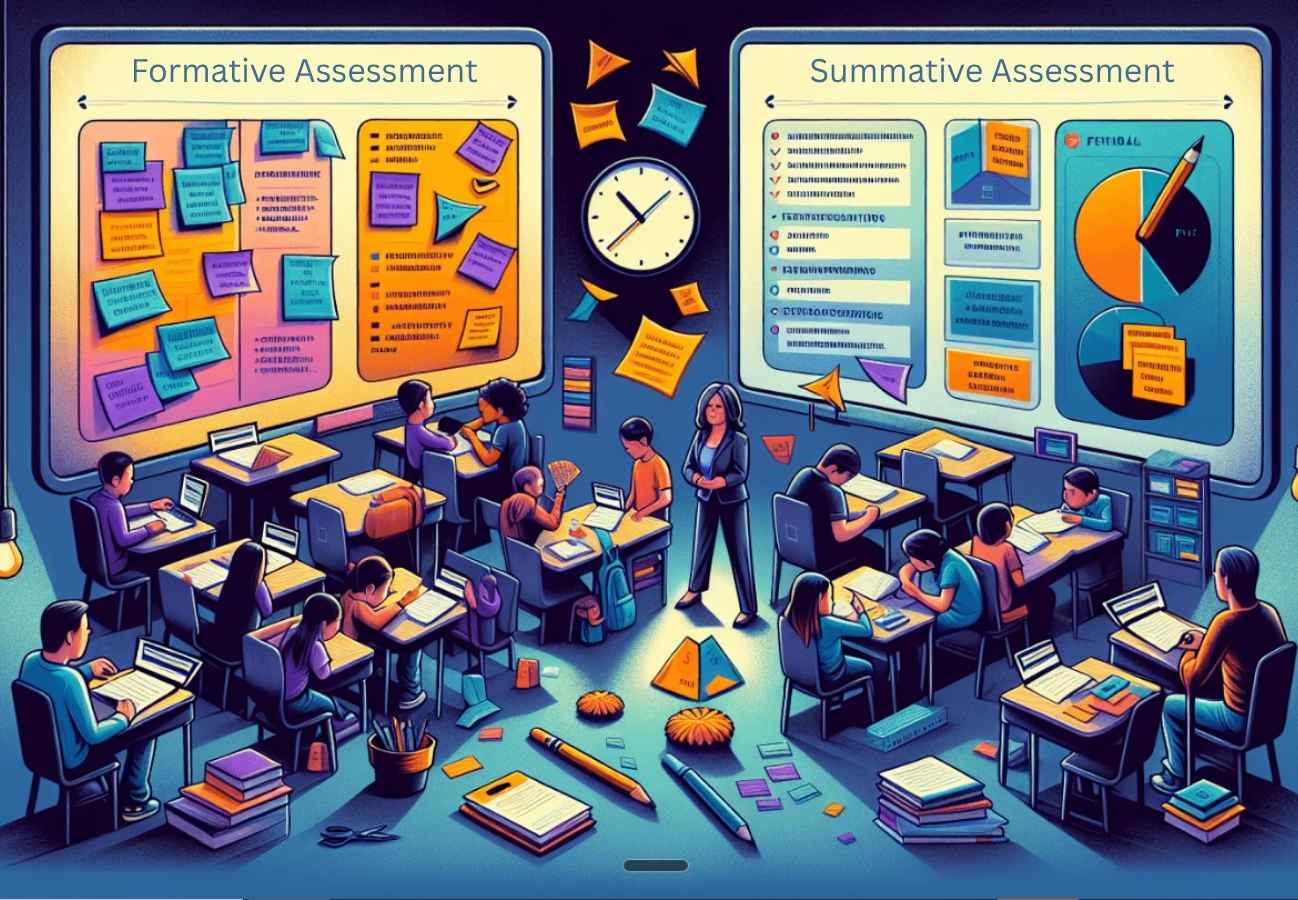
Assessment shouldn't just measure learning at the end. Formative assessment provides ongoing feedback during learning, allowing teachers to adjust and students to improve.
20. Formative Assessment
Formative assessment checks understanding during learning, not after. It's low-stakes and used to guide instruction rather than assign grades.
Examples include questioning during lessons, observing student work, quick writes, exit tickets, or self-assessment. The key is using results to adapt teaching.
Read our guide on Formative vs Summative Assessment and explore additional tools in our guide Formative Assessment Tools
21. Exit Tickets
Exit tickets are brief prompts students complete at the end of a lesson. They might answer a question, solve a problem, identify something confusing, or reflect on their learning.
Teachers collect and review them to gauge understanding. This informs next lesson planning.
22. Self-Assessment and Reflection
Self-assessment develops metacognition - thinking about one's own thinking. Students evaluate their work against criteria, identify strengths and growth areas, and set goals.
This might include using rubrics to assess own work, keeping learning journals, setting weekly goals and reflecting on achievement, or completing pre/post self-assessments.
23. Peer Assessment
Peer assessment means students evaluate each other's work using established criteria. This develops critical thinking, deepens understanding of quality standards, and provides additional feedback.
Effective peer assessment requires clear criteria, training on constructive feedback, structured protocols, and emphasis on growth-focused language.
Scaffolding and Support Strategies
Scaffolding provides temporary support that helps students complete tasks they couldn't complete independently. As competence grows, scaffolds are gradually removed.
24. Scaffolding in Teaching
Scaffolding adjusts support based on student needs. When introducing new concepts, teachers provide significant support. As students demonstrate understanding, support decreases until students work independently.
Scaffolds might include breaking complex tasks into smaller steps, providing sentence starters, offering worked examples, using graphic organizers, or chunking information.
Explore our guide on Scaffolding in Teaching
25. Graphic Organizers
Graphic organizers are visual tools that help students organize information and see relationships. Examples include Venn diagrams for comparing, flow charts for sequencing, concept maps for connections, or T-charts for pros/cons.
These tools reduce cognitive load by externalizing thinking. Students can manipulate information visually instead of holding multiple ideas in working memory.
26. Sentence Frames and Stems
Sentence frames provide language structures that help students articulate thinking, especially in academic discussions.
Examples: "I agree with ___ because ___," "This reminds me of ___," "The evidence suggests ___," or "One similarity between ___ and ___ is ___."
These supports benefit all students learning academic language but particularly help English language learners and students with language processing challenges.
Technology-Enhanced Teaching Strategies
Technology offers new possibilities for learning but should enhance pedagogy, not replace it. See below some strategies that leverage technology purposefully.
27. Flipped Classroom
Flipped classroom reverses traditional homework and classwork. Students engage with content (videos, readings) at home, then use class time for application, practice, and discussion.
This maximizes teacher support when students need it most - during application. Instead of struggling alone with homework, students work through challenges with teacher and peer support.
28. Blended Learning
Blended learning combines online and face-to-face instruction. This might mean station rotation, flex model (primarily online with teacher support), or enriched virtual (mostly online with periodic face-to-face sessions).
Blended learning allows personalization at scale. While some students work online at their pace, teachers provide targeted small-group instruction.
Explore our guide on Blended Learning
29. Gamification in Education
Gamification applies game mechanics - points, levels, badges, challenges - to learning contexts. The goal is increasing engagement and motivation through elements that make games compelling.
Effective gamification includes clear goals, immediate feedback, progressive challenge matching skill level, meaningful choice, and rewards connected to mastery.
Technology enables sophisticated gamification through adaptive platforms, but even low-tech classrooms can use gamification principles through narrative frameworks, team challenges, or mystery problems.
Choosing the Right Teaching Strategy
No single strategy works for everything. Effective educators select strategies based on multiple factors.
Consider learning objectives. What should students know and do? Remembering information uses different strategies than analyzing or creating.
Know your students. What's their prior knowledge? What's their readiness level? What interests them? A strategy that works with one group might not work with another.
Match strategy to content. Some content naturally suits certain strategies. Hands-on investigations work for science. Socratic seminars work for analyzing literature. Explicit teaching works for introducing procedures.
Experiment and reflect. Try strategies, gather evidence of learning, and adjust. Over time, educators build intuition about when to use which strategies.
Implementing Teaching Strategies Effectively
Knowing strategies isn't enough. Implementation determines whether strategies improve learning.
Layer strategies within lessons. Effective teaching combines multiple strategies. A lesson might include explicit teaching for introduction, think-pair-share for processing, graphic organizers for notes, and exit tickets for assessment.
Teach students how to engage. Don't assume students know how to work cooperatively or give peer feedback. Model expectations and practice.
Give strategies time to work. Students need practice before strategies become effective. The first Socratic seminar might feel awkward. That doesn't mean it doesn't work.
Avoid using strategies as gimmicks. Every strategy should connect to learning objectives. If you can't articulate why you're using it, reconsider.
Reflect on effectiveness. Did students learn what you intended? How do you know? What would you adjust next time?
Brain-Based Teaching Methods
These 29 teaching strategies connect to how our brains actually learn.
Active learning aligns with how memory forms - through engagement and retrieval practice. Differentiation recognizes that brains develop at different rates. Scaffolding matches the zone of proximal development. Cultural responsiveness leverages the brain's need for relevance.
At LearnButWhy, we believe in grounding teaching strategies in neuroscience of learning. Understanding how brains process and retrieve information transforms how educators design learning experiences.
Our Mindshift Training Program helps educators shift from knowledge delivery to learning facilitation. We explore image of the learner, teaching postures, and how brain-based principles translate into practice.
Ready to map your teaching approach?
Assess your current practice and get a personalized roadmap:
Assess Your Teaching Mindset >>
Teaching Strategies as Learning Tools
Teaching strategies are tools, not mandates. The goal isn't using every strategy - it's building a flexible toolkit educators can draw from based on learning needs.
Effective teaching requires both breadth (knowing many strategies) and depth (using strategies skillfully). This develops through practice, reflection, and learning from both success and struggle.
The question isn't "Which strategy is best?" It's "Which strategy serves these learners, with this content, toward these objectives, right now?"
Related Resources: