

What Is Augmented Reality in Education?
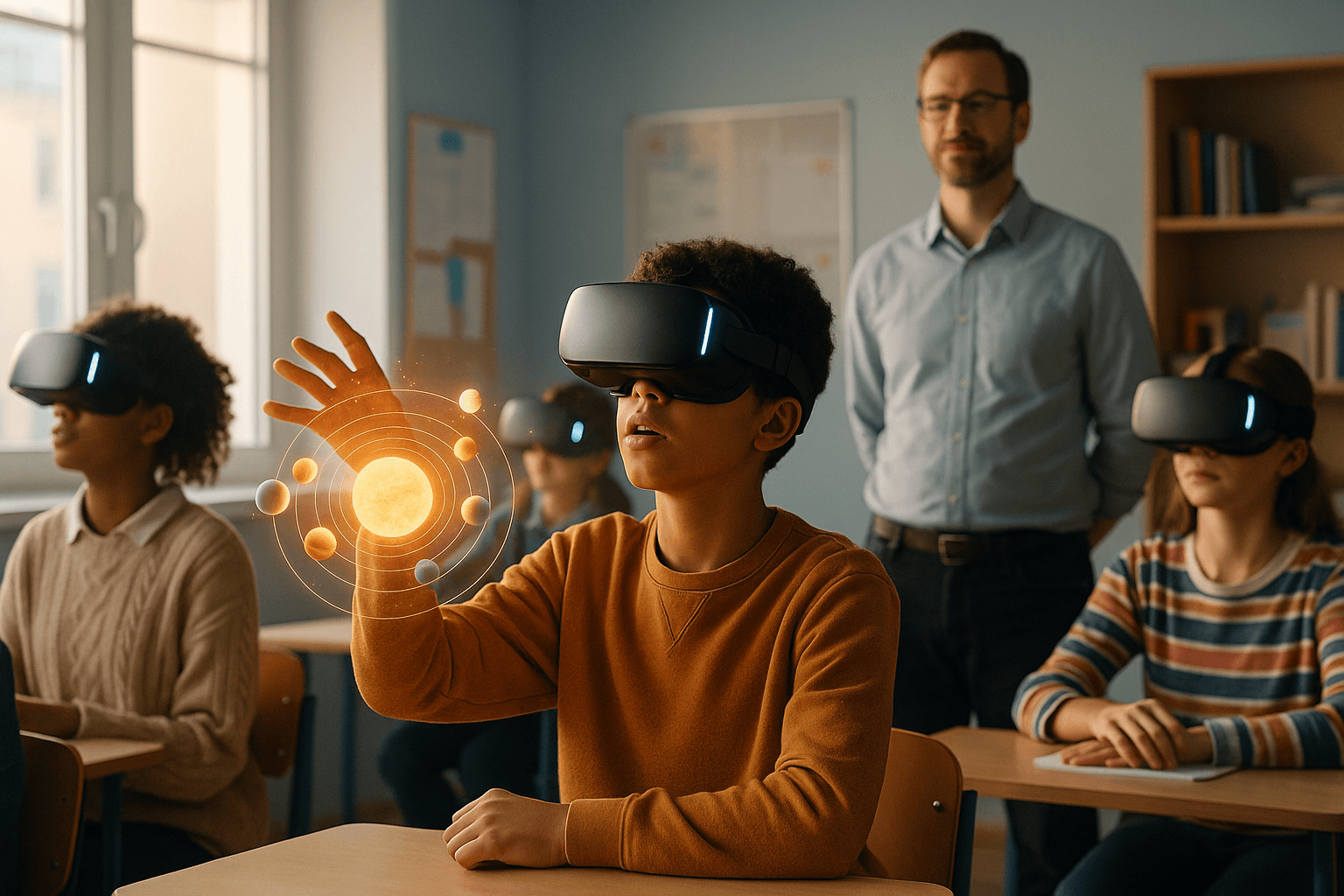
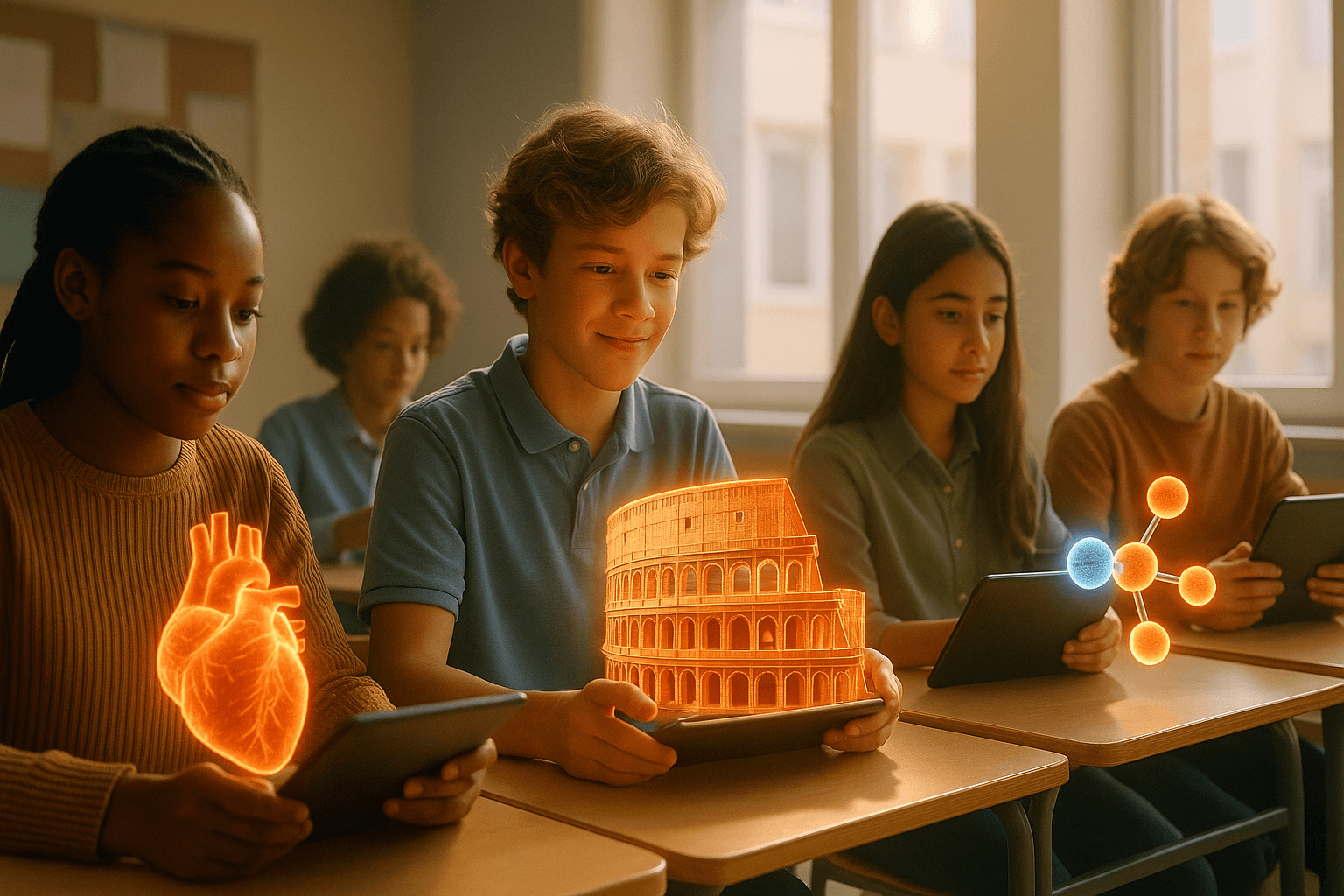
Augmented reality in education is the use of technology to overlay digital content — images, text, 3D models, or sound — onto the real world in real time. Unlike virtual reality, which replaces your surroundings entirely, AR enhances what students already see. A student points a tablet at a textbook page, and a human heart begins beating in 3D above the paper. That is augmented reality at work in a classroom.
AR tools are accessible through smartphones, tablets, and AR-enabled glasses. This makes them far more practical for most schools than full VR setups. The technology has moved well beyond novelty — research and classroom experience increasingly show it can deepen understanding in ways traditional instruction struggles to match.
Why Augmented Reality Matters for K–12 Learning
Students learn better when they can see, interact with, and explore ideas — not just read about them. AR creates exactly that kind of environment. It turns abstract concepts into visible, manipulable experiences.
A 2019 study published in the journal Computers and Education found that students using AR-based learning tools showed significantly higher engagement and retention compared to students using traditional materials. The effect was especially pronounced for spatial reasoning tasks and science concepts that are difficult to visualize on a flat page.
For educators, this matters because engagement is not just about fun. It is about reducing cognitive load — making it easier for the brain to process and store new information. When a student can rotate a 3D molecule or walk through an ancient Roman forum without leaving the classroom, the learning becomes anchored to experience rather than memorization.
How AR Supports Different Types of Learners
One of the most compelling arguments for AR in schools is its natural alignment with diverse learning needs. Visual learners benefit from 3D representations. Kinesthetic learners engage through interactive manipulation. Students with language barriers can access spatial and visual information that transcends text.
AR also offers a low-pressure environment for exploration. Students can make mistakes, reset, and try again without social consequence. That kind of psychological safety is something many classrooms still struggle to build through traditional methods alone.
Augmented Reality Applications Across Subject Areas
AR is not a single tool — it is a flexible layer that educators can apply across nearly every subject. The most impactful applications tend to share one quality: they make the invisible visible.
Science and Biology
Science education benefits enormously from AR. Students can explore the layers of the Earth, observe chemical reactions at the molecular level, or dissect a virtual frog without ethical concerns or supply costs. Apps like Visible Body and Anatomy 4D allow students to examine the human body in extraordinary detail.
For younger students, AR can bring ecosystems to life — showing food chains, habitats, and animal behavior in ways that static diagrams simply cannot replicate.
History and Social Studies
History becomes far more tangible when students can stand inside a reconstructed historical site. AR tools can place ancient civilizations, historical events, or geographic changes directly into the classroom. A lesson on the Berlin Wall becomes more resonant when students can see a reconstructed version of it through their device.
This kind of immersive context helps students develop empathy and perspective — skills that are central to civic education but notoriously hard to teach through textbooks alone.
Mathematics and Geometry
Geometry is one of the areas where AR shows the clearest academic benefit. Manipulating 3D shapes in real space helps students grasp volume, surface area, and spatial relationships far more intuitively than working from diagrams. Several studies have shown measurable improvements in geometry performance among students who used AR tools regularly.
For algebra and data literacy, AR can visualize functions and statistical distributions in ways that make abstract relationships feel concrete and logical.
Language Arts and Literacy
AR-enhanced books bring stories to life with animated characters and scenes. For early readers, this can dramatically increase motivation and comprehension. For older students, AR can support close reading by providing contextual overlays — historical background, vocabulary definitions, or author commentary — directly on the text.
Real Classroom Examples of AR in Practice
Theory is only useful when it connects to what actually happens in schools. Across the country, educators are finding practical, sustainable ways to bring AR into their instruction.
Elementary Classrooms Using AR for Science Exploration
In elementary settings, teachers have used apps like Metaverse and Google Expeditions (now integrated into other platforms) to take students on virtual field trips. A third-grade class studying the rainforest can observe canopy animals and plant life through a tablet without leaving the building. Teachers report that follow-up discussions after these experiences are noticeably richer and more detailed.
Middle School AR Projects That Build Student Agency
Some middle school teachers have moved beyond consuming AR content and into having students create it. Using tools like CoSpaces Edu, students build their own AR environments to demonstrate understanding of a topic. A student explaining the water cycle builds a 3D animated model and presents it to the class. This approach combines content knowledge with digital literacy and communication skills.
High School and Career-Readiness Applications
At the high school level, AR connects academic learning to career pathways. Engineering students use AR to prototype designs. Medical pathway students practice procedures in simulated environments. Architecture and design students visualize spatial concepts before committing to physical models.
These applications do more than teach content — they prepare students for industries where AR and spatial computing are becoming standard professional tools.
Benefits of Augmented Reality in the Classroom
The evidence base for AR in education is still growing, but several consistent benefits have emerged across multiple studies and classroom implementations.
- Increased student engagement and time-on-task during lessons
- Improved retention of complex or abstract concepts
- Greater accessibility for students with diverse learning needs
- Stronger motivation, particularly among students who disengage from traditional instruction
- Richer collaborative learning when students work together on shared AR tasks
Researchers at the University of Maryland found that people recall information better when they learn it in an AR environment compared to a traditional desktop setting. The study suggested that AR leverages spatial memory — the same cognitive system humans use to navigate physical space — which is one of our most powerful memory systems.
Challenges and Honest Limitations of AR in Education
No technology is a silver bullet, and AR is no exception. Educators deserve an honest picture of the challenges involved.
Cost and Infrastructure Barriers
Device access remains a significant barrier in many schools. While smartphones have made AR more accessible, not every student has a compatible device, and school-issued tablets vary widely in capability. Reliable Wi-Fi is also essential for most AR applications, and many schools — particularly in rural or under-resourced areas — still struggle with connectivity.
Teacher Preparation and Confidence
Technology adoption in schools almost always stalls when teachers feel unprepared. AR is no different. Many educators express interest in AR but feel unsure about how to integrate it meaningfully rather than as a one-off novelty. Professional development that connects AR tools to specific learning goals — rather than just demonstrating the technology — is essential.
School leaders play a critical role here. When administrators create time and space for teachers to experiment, reflect, and collaborate around new tools, adoption becomes sustainable rather than superficial.
Screen Time and Distraction Concerns
Parents and educators reasonably question whether adding more screen time is always beneficial. The key distinction is purposeful use. AR used to explore a concept, solve a problem, or demonstrate understanding is categorically different from passive screen consumption. Clear learning objectives and structured reflection help ensure AR serves the lesson rather than distracting from it.
How School Leaders Can Support AR Integration
Sustainable AR adoption requires more than purchasing apps or devices. It requires deliberate leadership and a shared vision for how technology serves learning.
Start with Learning Goals, Not Technology
The most common mistake in EdTech adoption is leading with the tool rather than the outcome. School leaders and curriculum coaches should help teachers identify specific learning challenges — concepts students consistently struggle with — and then explore whether AR offers a meaningful solution. This approach keeps pedagogy at the center.
Build Collaborative Teacher Networks
Teachers who see peers using AR successfully are far more likely to try it themselves. Creating structured time for educators to share AR experiments, reflect on what worked, and troubleshoot together builds both confidence and collective knowledge. Instructional coaches can facilitate this process by connecting willing early adopters with curious colleagues.
Evaluate Impact with Student Data
School leaders should establish simple ways to measure whether AR is actually improving learning outcomes. Pre- and post-assessments, student reflection surveys, and observation data can all provide useful signals. The goal is not to prove AR works universally — it is to understand when and how it works best in your specific school context.
The Future of Augmented Reality in Education
AR in schools is still early in its trajectory, but the direction is clear. As devices become lighter, cheaper, and more capable, and as 5G connectivity expands, the barriers to widespread AR adoption will continue to fall.
Emerging developments worth watching include spatial computing platforms that blend AR with AI, allowing systems to respond intelligently to student actions in real time. Imagine an AR science simulation that adjusts its complexity based on a student's demonstrated understanding — scaffolding in real time without teacher intervention.
Wearable AR devices, currently expensive and limited, will likely become more practical for school settings within the next decade. When that happens, the line between the physical classroom and the digital learning environment will blur in ways that could fundamentally reshape how we think about instruction.
AR and the Broader EdTech Ecosystem
Augmented reality does not exist in isolation. It sits within a broader ecosystem that includes adaptive learning platforms, learning management systems, and AI-driven assessment tools. The schools that will benefit most from AR are those that approach it as one component of a coherent, student-centered technology strategy — not a standalone solution.
The question for educators is not whether AR will become part of schooling. It almost certainly will. The more important question is whether schools will shape how it gets used, or simply react to it after the fact. That choice belongs to educators and leaders who are willing to engage thoughtfully with what the technology makes possible.
Getting Started with AR in Your School or Classroom
You do not need a large budget or a technology coordinator to begin exploring AR. Many high-quality AR tools are free or low-cost, and most work on devices schools already own.
A practical starting point is to choose one unit or concept where students consistently struggle — something abstract, spatial, or hard to visualize — and identify one AR tool that addresses it directly. Use it with one class, reflect on what happened, and share what you learned with a colleague. That is how sustainable change actually begins in schools.
Some widely used, educator-recommended AR platforms to explore include:
- CoSpaces Edu — for student-created AR and VR environments
- Merge Cube — a physical cube that transforms into interactive 3D objects
- Google Arts and Culture — AR experiences tied to art, history, and science
- Visible Body — detailed human anatomy in 3D
- Quiver — AR coloring pages for younger students
Each of these tools has a learning curve, but none requires advanced technical skill. What they do require is a willingness to try, reflect, and iterate — which is, after all, exactly what we ask of our students every day.