

What Is Virtual Reality in Education?
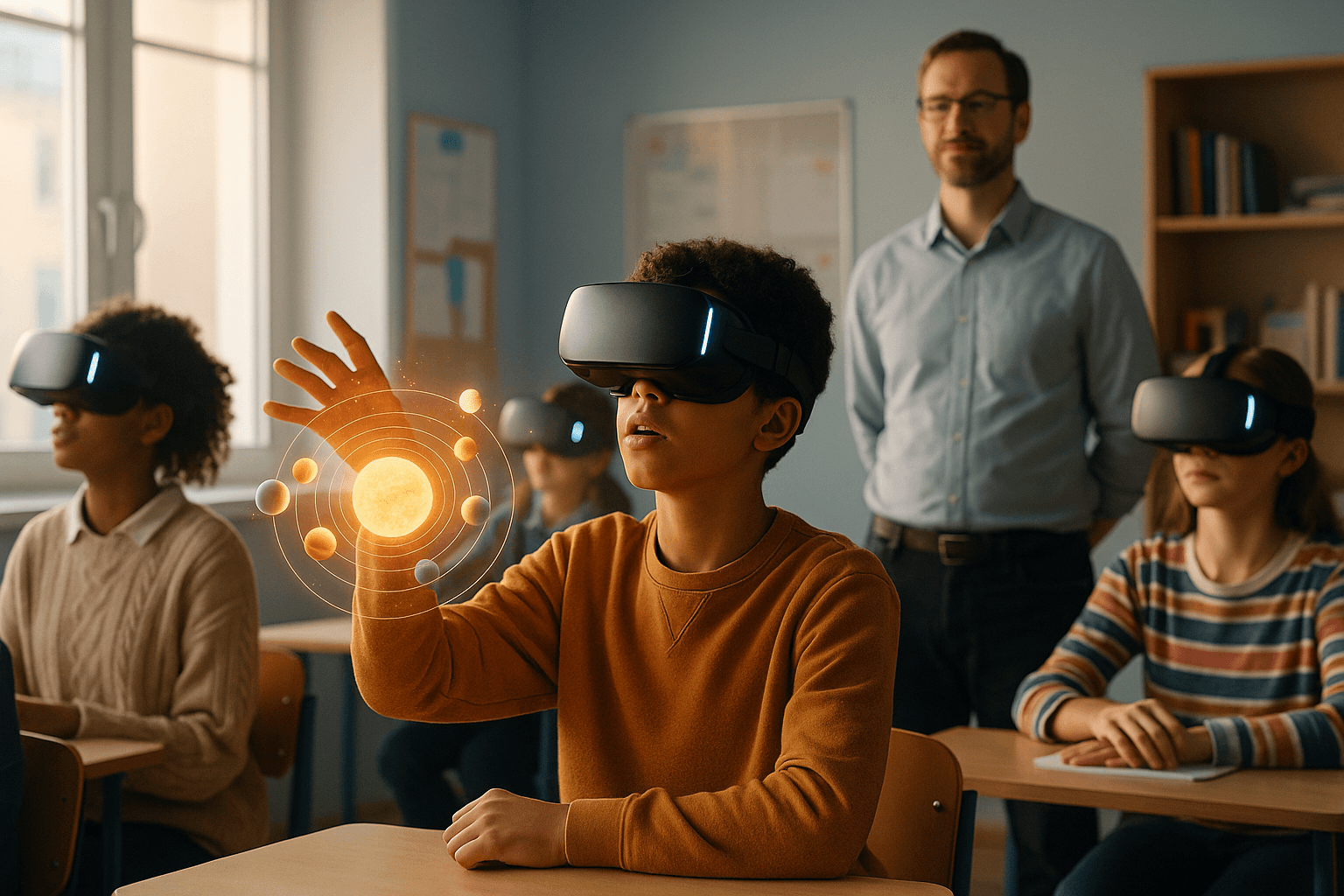
Virtual reality in education is the use of immersive, computer-generated environments to support teaching and learning. Students wear a headset or use a screen-based interface to enter a simulated world where they can explore, interact, and experience content in three dimensions. Unlike watching a video or reading a textbook, VR places the learner inside the experience itself.
This shift from passive observation to active participation is what makes VR genuinely different from other educational technologies. A student studying the water cycle does not just read about evaporation — they stand inside a cloud formation and watch it happen around them.
Why Virtual Reality Matters for K–12 Learning
The case for VR in classrooms is not about novelty. It is about what we know regarding how students actually learn.
Research in cognitive science consistently shows that people retain information more effectively when they engage multiple senses and feel emotionally present in an experience. A 2019 study from PricewaterhouseCoopers found that learners in VR environments were up to four times more focused than their peers in traditional classroom settings. Separate research published in the journal Computers and Education found that immersive learning environments improved both knowledge retention and motivation compared to conventional instruction.
These findings align with what educators have long understood intuitively: students learn better when they care, when they feel present, and when the material connects to something real.
The Connection to Experiential Learning Theory
David Kolb's experiential learning theory argues that learning happens through a cycle of experience, reflection, conceptualization, and experimentation. VR supports this cycle naturally. It gives students a concrete experience to reflect on, a foundation for building abstract concepts, and a safe space to test ideas without real-world consequences.
This is especially powerful for learners who struggle with abstract content. A student who finds it hard to visualize the scale of the solar system from a diagram may grasp it immediately when they stand on a simulated Martian surface and look back at Earth.
How VR Is Used in Classrooms Today
VR applications in education span nearly every subject area and grade level. The range is broader than most educators realize.
Science and STEM Education
Science classrooms have embraced VR with particular enthusiasm, and for good reason. Virtual labs allow students to conduct experiments that would be impossible, dangerous, or too expensive in a physical setting. Students can dissect a virtual frog, simulate chemical reactions, or explore the inside of a human cell.
NASA and organizations like the Howard Hughes Medical Institute have developed VR content specifically for classroom use, giving students access to environments no field trip could replicate.
History, Geography, and Social Studies
History becomes something entirely different when students can walk through ancient Rome or stand at the edge of the Grand Canyon. Google Expeditions, one of the most widely used VR tools in K–12 schools, built a library of over 900 virtual tours covering historical sites, natural wonders, and cultural landmarks.
Geography instruction benefits enormously from this kind of immersive context. Students who have virtually visited the Amazon rainforest or the Arctic tundra carry a different kind of understanding than those who only studied maps.
Social-Emotional Learning and Empathy Development
One of the most compelling and underutilized applications of VR in education is empathy training. Immersive experiences that place students in another person's perspective — a refugee navigating displacement, a person experiencing a disability, or a historical figure facing injustice — can build emotional understanding in ways that text alone rarely achieves.
Stanford University's Virtual Human Interaction Lab has produced research suggesting that VR experiences designed around perspective-taking can meaningfully shift attitudes and increase prosocial behavior. For school leaders thinking about character education, this is worth serious attention.
Career and Vocational Preparation
VR is also reshaping how schools approach career readiness. Students can virtually shadow a surgeon, operate heavy machinery in a simulated environment, or practice public speaking in front of a virtual audience. These experiences reduce anxiety, build confidence, and give students a more grounded sense of what different careers actually involve.
Benefits of Virtual Reality in Education
The advantages of VR in learning environments go beyond engagement. They touch the core of what effective education looks like.
- Students experience content rather than just consuming it, which deepens comprehension.
- VR removes geographic and economic barriers to rich learning experiences.
- Learners can make mistakes in safe, consequence-free environments and try again immediately.
- Students with different learning styles — particularly visual and kinesthetic learners — often thrive in VR settings.
- VR can reduce anxiety around high-stakes skills practice, such as presentations or lab work.
Equity deserves special mention here. A student in a rural school with limited resources can virtually visit the Louvre, explore the Great Barrier Reef, or walk through the streets of ancient Athens. That kind of access was once reserved for students with significant financial privilege. VR changes that equation.
Challenges and Limitations of VR in Schools
Honest enthusiasm requires honest assessment. VR in education comes with real challenges that school leaders and teachers need to think through carefully.
Cost and Infrastructure
High-quality VR headsets remain expensive. Meta Quest devices, for example, currently range from $300 to $500 per unit. Outfitting a classroom of 30 students represents a significant capital investment. Schools must also consider content licensing, technical support, and device management.
Lower-cost alternatives exist. Google Cardboard and smartphone-based VR viewers bring the price down considerably, though with reduced immersion and functionality. The gap between what is affordable and what is most effective remains a real tension for most school budgets.
Health and Safety Considerations
Extended use of VR headsets can cause eye strain, headaches, and disorientation — a phenomenon sometimes called simulator sickness. Most manufacturers recommend limiting sessions to 20–30 minutes, particularly for younger children. The American Academy of Pediatrics has raised questions about prolonged screen exposure for children under 12, and VR adds a layer of intensity to that concern.
Schools implementing VR programs should establish clear usage guidelines and monitor student responses carefully.
Pedagogical Integration
Technology does not teach by itself. A VR headset placed in a classroom without thoughtful curriculum integration is just an expensive novelty. The most effective VR programs connect directly to learning objectives, include structured reflection time, and position the VR experience as one part of a broader instructional sequence.
Teachers need training — not just in how to operate the technology, but in how to design learning experiences around it. This is where school leadership plays a critical role.
Practical Steps for Educators Considering VR in the Classroom
Getting started with VR does not require a massive budget or a complete curriculum overhaul. Small, intentional steps tend to produce the most sustainable results.
Start with a Single Subject and a Clear Goal
Choose one unit, one learning objective, and one VR experience to pilot. Measure student engagement and comprehension before and after. Gather student and teacher feedback. Let the evidence guide your next decision rather than enthusiasm alone.
Explore Free and Low-Cost VR Platforms
Several high-quality VR platforms offer free or low-cost content for educators:
- Google Arts and Culture offers virtual tours of museums and historical sites.
- Nearpod includes immersive VR lessons aligned to curriculum standards.
- Labster provides virtual science labs for secondary and post-secondary students.
- YouTube's 360-degree video library contains thousands of immersive experiences accessible on any device.
Starting with existing content reduces preparation time and lets teachers focus on the pedagogical design rather than content creation.
Build in Reflection and Discussion Time
The VR experience itself is not the lesson — it is the catalyst. What students do immediately after the experience matters just as much. Structured discussion, journaling, or collaborative analysis helps students process what they experienced and connect it to broader learning goals.
This is where VR transitions from a cool activity into genuine learning.
The Future of VR in Education
The trajectory of VR technology points toward experiences that are more accessible, more affordable, and more deeply integrated into everyday learning.
Augmented Reality and Mixed Reality as Companions
Augmented reality (AR) overlays digital content onto the physical world, while mixed reality blends both environments seamlessly. These technologies share VR's immersive qualities but require less specialized hardware. Apple's Vision Pro and similar devices signal a future where the boundaries between physical and digital learning environments become increasingly fluid.
For educators, this means the principles being developed around VR today will apply to a much broader landscape of immersive technology tomorrow.
AI-Powered Personalization Within VR Environments
Emerging platforms are beginning to combine VR with artificial intelligence to create adaptive learning experiences. A VR environment might adjust its complexity, pacing, or content based on how a student responds in real time. This kind of personalization has long been a goal of educational technology, and immersive environments may be where it finally becomes practical at scale.
What School Leaders Should Watch
The most important question for school leaders is not whether VR will become more prevalent in education — it almost certainly will. The more important question is whether schools will be thoughtful about how they integrate it.
History offers a cautionary note here. Interactive whiteboards, tablets, and online learning platforms all arrived with significant promise and uneven results. The difference between technology that transforms learning and technology that simply occupies students usually comes down to whether educators were genuinely involved in the design and implementation process.
VR deserves the same critical, curious, and open-minded approach that good educators bring to every new tool.
Is Virtual Reality Right for Your School?
The honest answer is: it depends. VR is not a universal solution, and it is not the right fit for every school, every subject, or every student at every moment. But for the right learning objective, with thoughtful implementation and teacher support, VR can create experiences that students carry with them long after the headset comes off.
That kind of lasting impression — the kind that changes how a student sees the world — is what education is ultimately for. If VR helps get us there more often, it is worth the effort to understand it well.