


Our focus since the beginning of January was compiling the last two decades of research on neuroscience of learning. As part of this, I got reacquainted with the work of neuroscientist Mary Helen Immordino-Yang on adolescent brain development and was pleasantly surprised to find some of her interview videos on YouTube - see the end for links.
While listening to her, I found myself pausing repeatedly to connect her words to our work at LearnButWhy. So throughout this piece, you'll find key quotes and insights from her that resonated with me.
Why Do We Have to Learn This?
Mary Helen Immordino-Yang describes what happens when teenagers ask "Why do we have to learn this?"
We treat it as a discipline problem, a form of resistance. But here's what they're actually asking:
“What they’re really asking is, ‘How does this connect to me as a person? How does this help me understand my life, my community, my world?’ And those are completely legitimate questions.”
We shut down these questions because we’re focused on coverage, getting through the curriculum. But these are exactly the questions that unlock deep learning.
And then her research reveals something that reframes everything: The same brain regions that keep you alive are the ones that make you care about ideas.
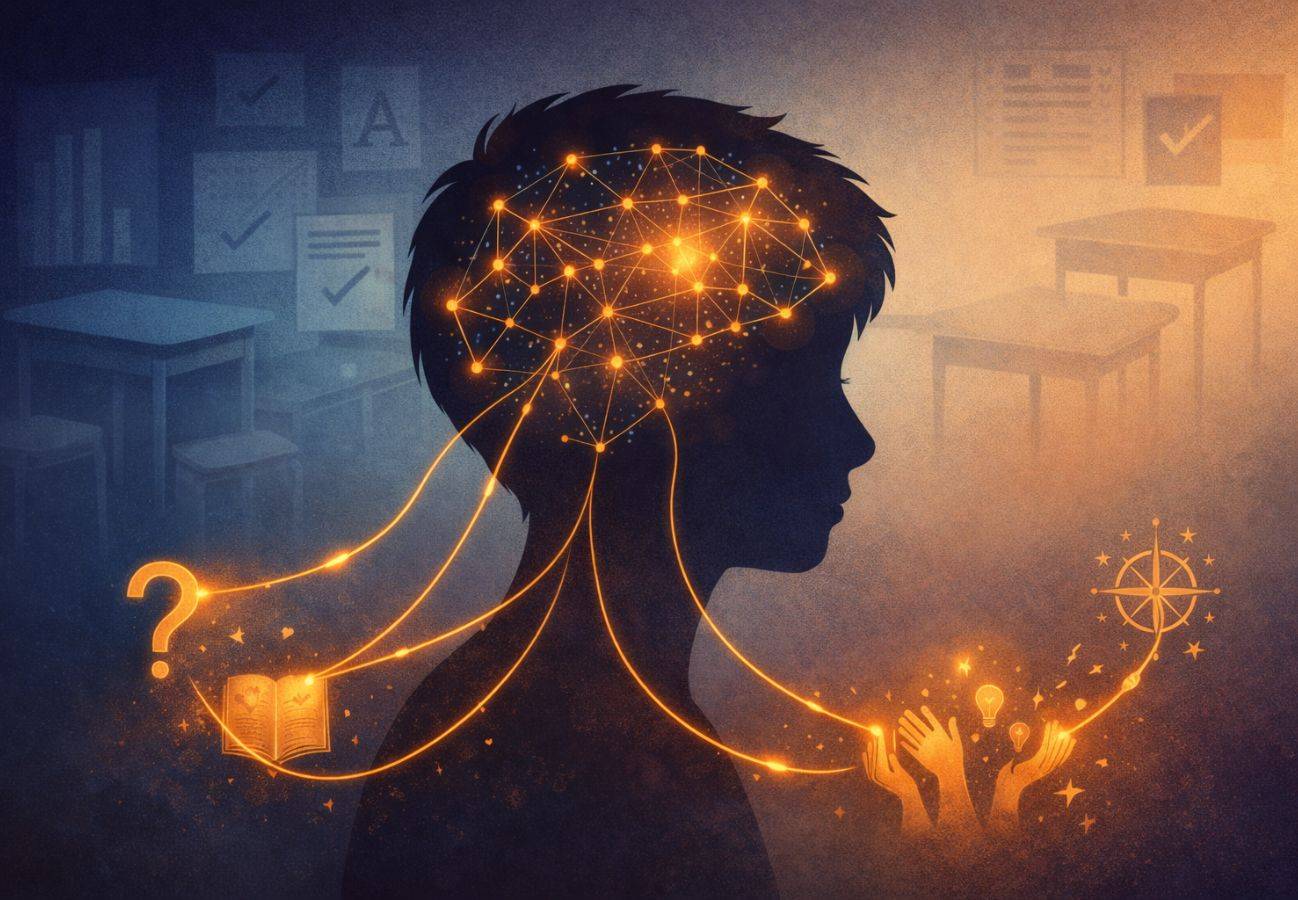
Our Brain’s Compass for What Matters
“Whatever you’re having emotion about is what you’re thinking about.”
Here’s what the research reveals: Emotions aren’t distractions from thinking. They’re our brain’s calibration system for what matters.
When something 'feels like me' when I’m thinking about some content, that’s not metaphor. That’s my brain’s survival systems - the ones managing bodily arousal, keeping me alive - determining that this information is relevant enough to integrate into who I am.
“The feeling IS the thinking. It’s the way that your body and your deep brain systems are telling your thinking brain, ‘This matters. Pay attention to this. This is worth organizing your understanding around.’”
This is what Immordino-Yang’s work shows us: the feeling isn’t separate from the thinking and identity isn't separate from learning.
“Your identity is the organizing framework for your learning. It’s the story you’re telling yourself about who you are and what you care about and how you understand the world. And all of your learning gets organized into that story.”
The facts and skills that connect to your identity? Those stick. They transfer to new situations and become tools for making sense of the world.
The facts and skills disconnected from identity? Those disappear as soon as the test is over.
Where are you in understanding this shift?
The Educator Mindset Assessment helps you identify your current mental models about learning and teaching.
The Current Education System Gets It Backwards
The brain is efficient. It doesn't waste energy on information that doesn't connect to anything that matters.
Once the brain has that organizing framework - that sense of meaning and relevance - then skills and knowledge have somewhere to stick.
And here's what education gets backwards: We assume meaning follows from accumulated facts. Building from the roots up - master the basics first, then eventually you'll understand the big ideas.
But minds don't work with building blocks like trees growing from a single trunk. They work more like networks - starting from what matters, then spreading connections in multiple directions simultaneously.
Skills and meaning aren’t either/or. They’re interdependent. You need both. But meaning comes first. Skills develop in service of that meaning, not the other way around.
Here’s the key: It’s the feeling, the identity connection, that coordinates this interdependence. Emotions calibrating relevance, identity organizing learning - that’s what makes skills and meaning work together.
And yes, this completely changes what students need to develop. It's not about more content knowledge, but different capacities entirely. Check out our List of 21st Century Skills and why we believe each one is important.
We’ve Aimed This Compass at the Wrong Target
So what do students today connect to emotionally?
Test scores. Grade point averages. Deadlines. College admission. Delivering the assignment. Pleasing the teacher. Satisfying the parents' needs for academic performance.
Their emotions aren’t about ideas. They’re about outcomes.
We’ve built a system that trains adolescents to aim their internal calibration systems at the wrong target.
That's why it feels OK for the student to use AI to complete the entire assignment without any tangible thinking. Producing the deliverable isn’t what matters. The coordination that happens in your brain while wrestling with ideas that may feel relevant to who you are - that’s what matters.
“Good schooling shifts the emotions of both the teacher and the students to emotions that are about the ideas rather than the outcomes and the results.”
When emotions are about the deliverable instead of the learning process, we know something fundamental is broken.
We have a precious window of brain plasticity in adolescence - when thinking patterns can actually grow the wiring of the brain. And we're using that window to drill disconnected facts and procedures. We're wasting a critical developmental opportunity.
How Do We Design Education Around This?
So what does good education look like when we understand this?
“Innovative schools are schools that start with big questions, compelling problems, real-world issues that students care about. And then they support students in developing the skills and knowledge they need to engage with those questions in increasingly sophisticated ways.”
This means building learning environments, where emotions are about ideas, not outcomes. Where students and teachers wrestle together with questions that don’t always have clean answers.
AI Makes This Shift More Urgent - Not Obsolete
“I worry that in our rush to integrate AI into education, we’re going to double down on all the things that are already problematic. We’re going to use AI to personalize skills practice, to make kids more efficient at answering multiple choice questions, to give them instant feedback on their procedures.”
We risk amplifying what's already broken - using powerful tools to make students more efficient at meaningless work.
But humans have complicated bodies with deep, emotional systems. We care, get motivated, find meaning. We think through stories, through embodied experience, through meaning-making that integrates emotion and cognition. That's what gives direction to learning and truly personalizes the journey for each of us.
We Need Teachers To Model Deep Thinking and Meaning-Making
Teachers become more important, not less, in the age of AI. AI can deliver content beautifully. But it can't model what it means to be human, to care about ideas, to wrestle with complexity and uncertainty.
Teachers have the capacity to show students what it looks like to be thoughtful, caring meaning-makers. That modeling is irreplaceable.
In order to achieve this, teachers should be able to do this thinking and wondering out loud. Question their own assumptions. Make connections to their own values and experiences. They need to show students what 'thinking deeply' and pursuing meaning actually looks like.
“The teacher’s role is not to have all the answers. It is to be a more experienced meaning-maker who can support students in their own meaning-making. It’s to be curious alongside students, to model what it looks like to grapple with complexity, to admit uncertainty.”
This Requires a Mindshift, Not Just New Techniques
This is why we do not offer 'better teaching techniques' at LearnButWhy.
Real transformation requires serious personal work:
- Understanding what learning actually is at a neurological level. Not as abstract theory, but direct engagement with research and ideas.
- Experiencing it yourself. Educators must reflect, challenge their mindsets and attitudes and become curious inquirers in order to get equipped to facilitate all of this.
- Sustained support of a learning community. This shift requires inquiry. It requires identifying and breaking one's patterns while experimenting with new ones. It takes ongoing reflection with peers who help you see your own assumptions and sustain the inquiry mindset.
So we've focused our efforts on training programs, facilitation of a personal reflection process and infrastructure for learning communities.
Until next time,
Onur
Founder, LearnButWhy
*The quotes throughout this newsletter come from Mary Helen Immordino-Yang's research and interviews on adolescent brain development and learning.
Want To Learn More?
From Mary Helen Immordino-Yang:
- Teaching and Learning in the Age of AI (Youtube, 2025)
- The Well Interview (Youtube, 2024)
- Andrew Huberman Podcast (Youtube, 2023)
- Building Meaning Builds Teens’ Brains (ASCD, 2020)
- USC Center for Affective Neuroscience, Development, Learning and Education (CANDLE)
From LearnButWhy: More articles on reimagining education
Missed a previous issue or want to subscribe? Visit: learnbutwhy.com/newsletter