


"I already know something's broken - but where do I even start?"
The last edition was about the identity crisis most educators are quietly experiencing:
- "How do I navigate all this constant change?"
- "What's my role becoming as AI delivers knowledge in a faster and more personalized way?"
- "Am I doing this right - using the right amount of technology at the right time and the right way?"
- "Am I alone in feeling lost?"
If these resonated, it's likely that you may be asking: OK understood, but now what?
Most of us know something fundamental needs to shift. But knowing this doesn't tell you what work comes next, or whether you're even making progress.
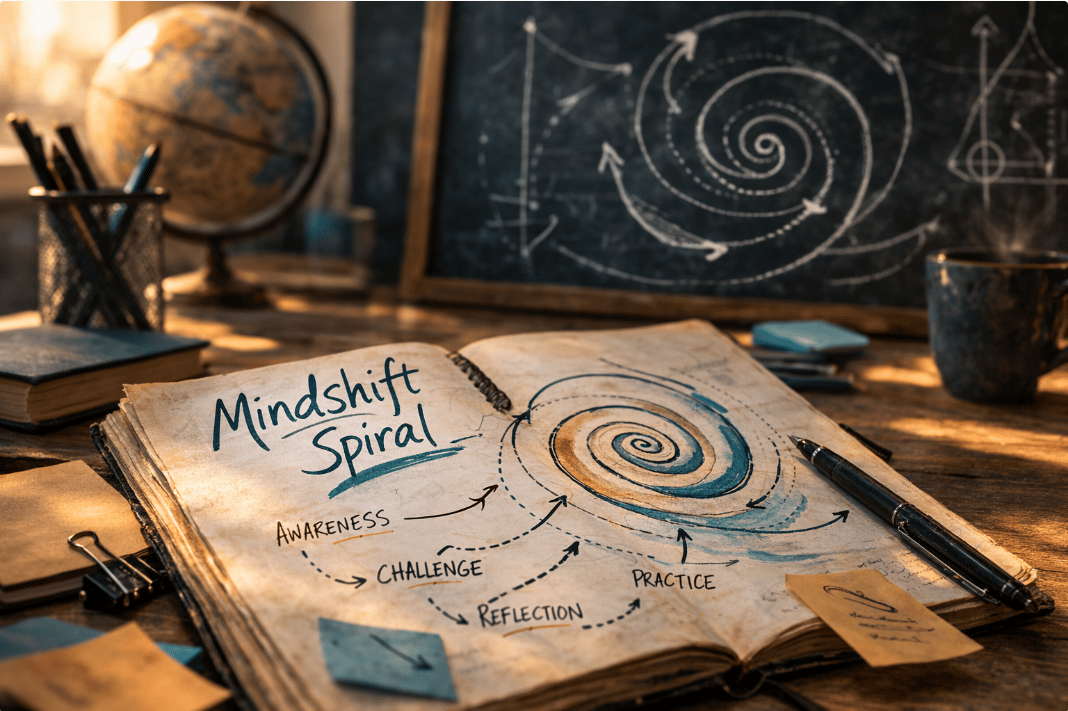
Need for a map, not another framework
It doesn't help to be forced to attend another professional development session that doesn't address these pressing concerns. And you surely do not need another cool AI tool or the next great framework for 21st-century learning.
What helps is to clearly see the map and where you stand right now on your own journey.
What also helps is to accept that everyone is somewhere along their path and that WHEREVER YOU ARE IS OKAY.
Adapting to all the ongoing change and then acquiring the attitudes and habits to stay adaptive - these require a significant transformation, a mindshift. And such transformation takes time.
The time it takes will be different for each person. But do expect to budget longer than a weekend workshop!
Knowing isn't the same as living
Here's a takeaway from my experience in business, art and education: "knowing about something is rarely the constraint."
Most of us already know that learning should be more personalized, kids should start from inquiry instead of repeating back the answers and that the role of the educator needs to evolve.
But knowing this is not enough to change what we're living day to day. There's a gap between knowing and living, where most of us get stuck.
Because knowing, putting into practice and truly living something new are three completely different phases of the journey.
The journey ahead
This is how transformation works as you try to adopt a truly new mindset:
- Knowing it: You understand intellectually what needs to change, but you still operate the old way. It's an important step because it kicks off a new mode of observation and awareness.
- Practicing it: The new knowledge starts challenging some of the old habits. You consciously need to try new approaches and build new habits. Sometimes you adopt a prescribed set of habits or practices, but you cannot yet take them forward or improvise with them.
- Living it: It's internalized by you and integrated. You don't have to think about it anymore. The new approaches feel natural. You feel comfortable enough to build your own practices or reshape existing ones that you had adopted.
Most professional development programs treat these as the same thing. Learn the concept, implement as soon as possible and done.
However, each phase requires different types of effort and support - reading, reflection, inquiry, experimentation, sharing and further reflection... It does not work to rush this process with quick fixes.
A spiral, not a straight line
And let's complicate the process further. We don't even progress neatly from knowing to practicing to living and then stay there.
We spiral.
There are many dimensions and layers to the practice of teaching. I might be living one aspect - let's say creating and holding an orderly space without instilling fear - while still just knowing another - like co-creating the curriculum with students.
You may practice something for months, then hit a difficult situation and find yourself regressing to old patterns. None of this is failure. That's the nature of any transformative work.
Transformative work is recursive by nature. You circle back through the same territory at deeper levels. This is why I call our mindshift program a "spiral".
The Mindshift Spiral maps the messy journey
We use the Mindshift Spiral as a map that shows where people are in their transformation.
See the full Mindshift Spiral framework >>
It acknowledges that we're working on multiple fronts simultaneously. And that it's OK when progress isn't linear.
The Spiral maps six phases of transformation across multiple dimensions of practice.
Where are you in this shift?
Most people navigating this transformation start without a clear picture of where they are, what's working or what's ready to shift.
That's why we built the Mindset Assessment around the Mindshift Spiral. It only takes 8-10 minutes.