


What Is an AI-Powered Personalized Learning Platform?
An AI-powered personalized learning platform is a digital education system that uses artificial intelligence to adapt instruction to each student's unique needs, pace, and learning style. Unlike traditional one-size-fits-all curricula, these platforms continuously analyze student performance data and adjust content, difficulty, and feedback in real time. The result is a learning experience that feels less like a conveyor belt and more like a conversation — one that actually listens.
These systems sit at the intersection of adaptive learning technology, machine learning, and educational psychology. They are not simply digital textbooks. They make decisions — about what a student sees next, how long they spend on a concept, and when they are ready to move forward.
Why AI Personalized Learning Is Reshaping K–12 Education
Every classroom contains students at wildly different readiness levels. A teacher managing 28 students cannot realistically deliver 28 different lesson plans each day. That gap between what students need and what a single educator can provide has always existed. AI-powered adaptive learning tools are the first technology to seriously address that gap at scale.
Research consistently shows that personalized instruction improves academic outcomes. A landmark study from the RAND Corporation found that students in schools using personalized learning approaches made greater gains in math and reading compared to peers in traditional settings. AI platforms operationalize that approach — making it sustainable without burning out teachers.
How AI Learns What Each Student Needs
The engine behind these platforms is a combination of machine learning algorithms and learning science frameworks. When a student answers a question, the system does not just record right or wrong. It tracks response time, error patterns, skip behavior, and engagement signals. Over time, a detailed learner profile emerges.
This profile drives what educators call a dynamic learning path — a sequence of content that shifts based on what the student demonstrates, not just what the calendar says they should know. Some platforms draw on knowledge graphs, mapping relationships between concepts so the system understands that a student struggling with fractions may first need to revisit multiplication.
The Role of Formative Assessment in AI Learning Systems
Formative assessment — the ongoing checking for understanding during learning — is where AI platforms genuinely shine. Traditional formative assessment depends on a teacher noticing a confused expression or reviewing exit tickets after class. AI systems run that process continuously, invisibly, and without adding to a teacher's workload.
When a student repeatedly misapplies a grammar rule, the platform flags it, adjusts the next activity, and may even alert the teacher through a dashboard. This creates a feedback loop that is faster and more precise than most classroom environments can sustain manually.
Core Features of the Best AI Learning Platforms for Schools
Not all AI education tools are built equally. School leaders evaluating platforms should look beyond marketing claims and examine what the system actually does with student data and how it supports — rather than replaces — teacher judgment.
The strongest platforms share several defining characteristics:
- Real-time adaptive content delivery that responds to student performance within a single session
- Transparent teacher dashboards that surface actionable insights, not just raw data
- Alignment to curriculum standards so AI-generated pathways connect to what teachers are already teaching
- Equity-aware design that accounts for access gaps, language needs, and learning differences
- Privacy-first data architecture that complies with FERPA, COPPA, and local data governance requirements
Platforms that check these boxes treat AI as a support structure, not a substitute for human educators. That distinction matters enormously in practice.
Intelligent Tutoring Systems vs. Adaptive Learning Platforms
These two terms often get used interchangeably, but they describe different things. An intelligent tutoring system (ITS) mimics one-on-one tutoring — it guides a student through problem-solving with hints, explanations, and targeted feedback. Carnegie Learning's MATHia is a well-known example.
An adaptive learning platform is broader. It may include tutoring elements, but its primary function is to manage and personalize the overall learning journey — sequencing content, adjusting difficulty, and tracking mastery across a curriculum. Both have a place in a well-designed EdTech ecosystem.
AI in the Classroom: What It Looks Like in Practice
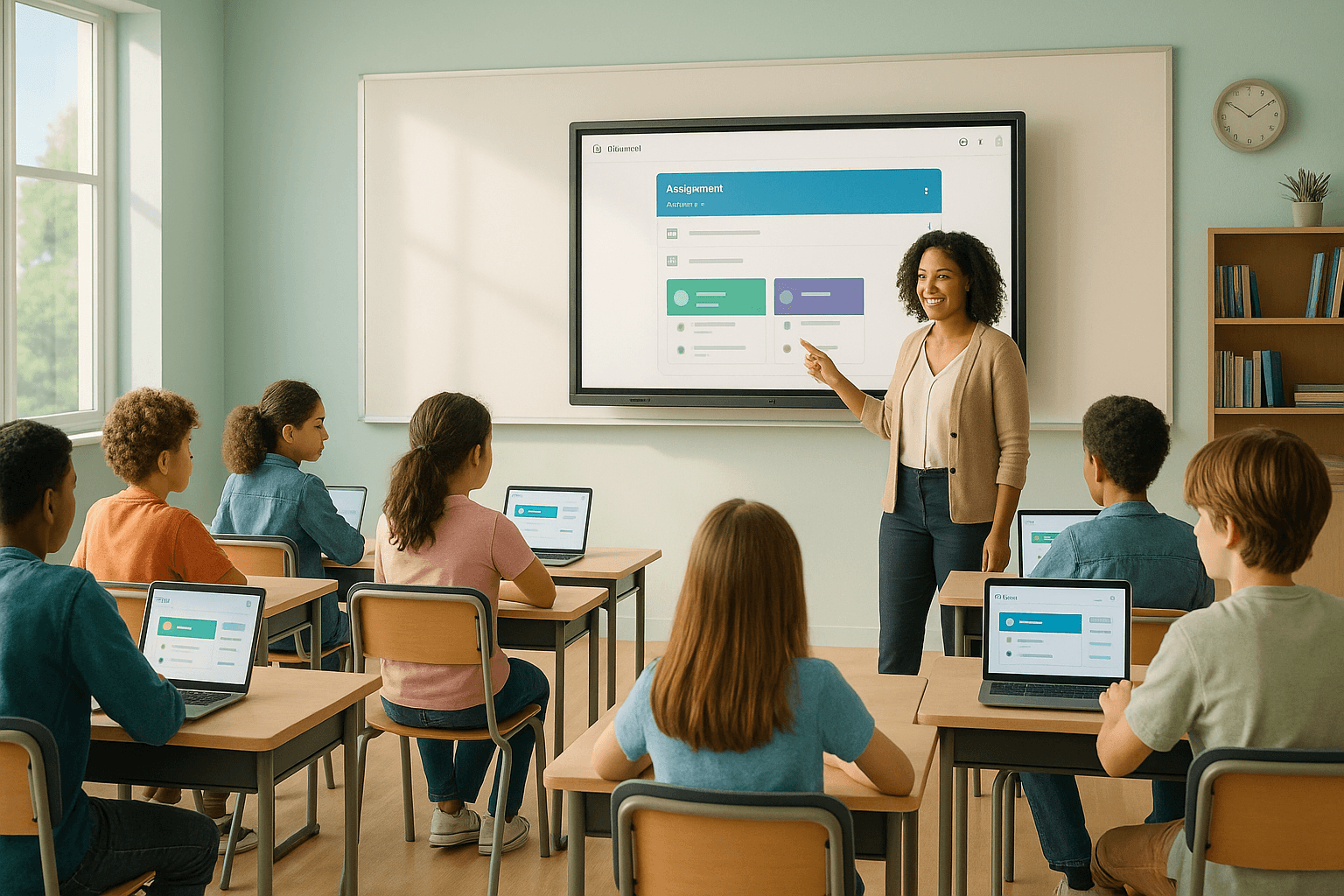
Theory is useful. Real classroom application is where decisions get made. Here is what AI-powered personalized learning actually looks like when it is working well inside a school.
Elementary School: Closing Early Literacy Gaps
A second-grade teacher uses an AI reading platform that listens to students read aloud and analyzes fluency, accuracy, and comprehension in real time. Students who struggle with phonemic awareness receive targeted decoding exercises. Students who are reading above grade level get enrichment texts. The teacher reviews a weekly summary and uses that time to pull small groups — informed by the data, not guessing.
Middle School: Differentiated Math Instruction at Scale
A sixth-grade math teacher assigns an AI-driven practice tool after direct instruction. The platform detects that several students have not yet mastered integer operations and loops them back before introducing algebraic expressions. Meanwhile, students who demonstrate mastery move ahead. The teacher spends class time on discussion, problem-solving, and relationship-building — the work that no algorithm can replicate.
High School: Supporting College and Career Readiness
A high school counselor uses an AI platform that maps student skill profiles against career pathway requirements. Students receive personalized course recommendations and skill-building modules. The system flags students whose academic trajectories may limit future options — early enough to intervene meaningfully.
Benefits of AI-Powered Learning for Students and Teachers
The case for AI in education is strongest when it centers on both learners and the educators who serve them. These platforms offer genuine advantages — when implemented thoughtfully.
For students, the most meaningful benefit is pacing. Learning at the right level of challenge — what psychologist Lev Vygotsky called the zone of proximal development — produces deeper understanding and stronger retention. AI platforms can maintain that zone continuously, something a single teacher managing a full classroom cannot always do.
For teachers, the benefit is clarity. Instead of relying on intuition or waiting for test scores, educators gain access to real-time learning data that surfaces who needs help and where. That shifts planning from reactive to proactive.
Reducing Learning Loss and Supporting Struggling Students
One of the most promising applications of AI adaptive learning is in recovery and intervention. Students who fall behind in foundational skills often carry those gaps forward for years. AI platforms can identify those gaps precisely and deliver targeted remediation — without stigmatizing the student or pulling them out of class in ways that feel punitive.
Post-pandemic learning recovery efforts in many districts have turned to AI-powered tools specifically for this reason. The ability to deliver high-dosage, personalized practice at scale — without requiring proportional increases in staffing — makes these platforms practically valuable in resource-constrained environments.
Challenges and Honest Limitations of AI Learning Technology
Any honest conversation about AI in education has to include the limitations. These platforms are powerful, but they are not magic — and uncritical adoption creates real risks.
The Risk of Over-Automating the Learning Experience
Students learn through relationships, discussion, struggle, and meaning-making — not just through optimized content delivery. A platform that keeps students on screens completing adaptive exercises for extended periods may improve certain metrics while diminishing the human dimensions of learning that matter most.
Education leaders should ask: how much of the school day is algorithm-directed versus teacher-directed? The answer should lean heavily toward the teacher. AI works best as a complement, not a curriculum.
Data Privacy and Algorithmic Bias in EdTech
AI systems learn from data — and data reflects the world as it has been, not as it should be. If a platform's training data overrepresents certain student populations, its recommendations may systematically underserve others. School leaders must ask vendors hard questions about how their models were trained and how bias is monitored and corrected.
Data privacy is equally non-negotiable. Student learning data is sensitive. Platforms must demonstrate clear data governance practices, and schools must review vendor agreements carefully before deployment.
Implementation Without Professional Development Fails
The most common reason AI learning platforms underperform in schools is not the technology — it is the implementation. Teachers who do not understand how to read platform dashboards, integrate AI insights into instruction, or manage student time on the tool will not get meaningful results.
Sustained professional development — not a one-day orientation — is essential. Teachers need time to experiment, reflect, and build confidence with these tools alongside their colleagues.
How School Leaders Can Evaluate AI Learning Platforms
Choosing an AI-powered learning platform is a significant decision. It involves budget, student data, instructional time, and teacher capacity. Leaders who approach this process rigorously protect their schools from costly mistakes.
A strong evaluation process includes:
- Reviewing independent research on the platform's efficacy — not just vendor-provided case studies
- Piloting with a small cohort before district-wide rollout
- Involving teachers in the selection process from the beginning
- Assessing the vendor's data privacy practices and compliance documentation
- Defining clear success metrics before implementation begins
The question is not simply whether a platform uses AI. The question is whether it uses AI in service of your students' specific needs — and whether your teachers will actually be able to use it well.
Questions Worth Asking Every EdTech Vendor
When vendors present their AI learning solutions, push past the demo. Ask how the adaptive algorithm works and what data it uses. Ask how teachers are expected to integrate the platform into their existing instructional routines. Ask what happens when a student's data suggests something unexpected — and who is responsible for acting on that signal.
The answers reveal whether a vendor sees schools as partners or as markets.
The Future of AI-Powered Education: What Is Coming Next
The field is moving quickly. Large language models are beginning to power conversational AI tutors that can engage students in open-ended dialogue — explaining concepts, answering questions, and adjusting explanations based on student responses. Early versions of these tools are already in classrooms.
Multimodal AI — systems that process text, audio, and visual input together — will expand accessibility for students with diverse learning needs. Real-time translation and language support will reduce barriers for multilingual learners. Emotion-aware AI, which detects signs of frustration or disengagement, is an emerging area with both promise and significant ethical complexity.
The Teacher's Role Will Evolve, Not Disappear
A common fear is that AI will replace teachers. That fear misunderstands what teaching actually is. Curriculum delivery is one part of teaching. Mentorship, motivation, cultural responsiveness, and human connection are the others — and no algorithm replicates them.
What AI will change is how teachers spend their time. Less time on rote differentiation tasks. More time on the relational and creative work that defines great teaching. That is not a threat to the profession. It is an invitation to reclaim its most meaningful dimensions.
The schools that will benefit most from AI-powered personalized learning are those that approach it with clear purpose, strong teacher leadership, and an unwavering commitment to the whole child — not just the data point.